Work at Equity
Here you'll find all of the jobs available to join our team at Equity. We'll post new job vacancies here as and when they become available.
Equity Jobs
When there are jobs available, they will appear on the page below. Please do get in touch with any questions or queries you may have.
Vacancies
Full time, permanent (35 hours per week)
Based in London
Salary on a scale starting at £70,854.32
30 days’ annual leave plus bank holidays and Christmas office closure
Defined Benefit Pension Scheme
Equity recognises Unite as the staff group union
Equity
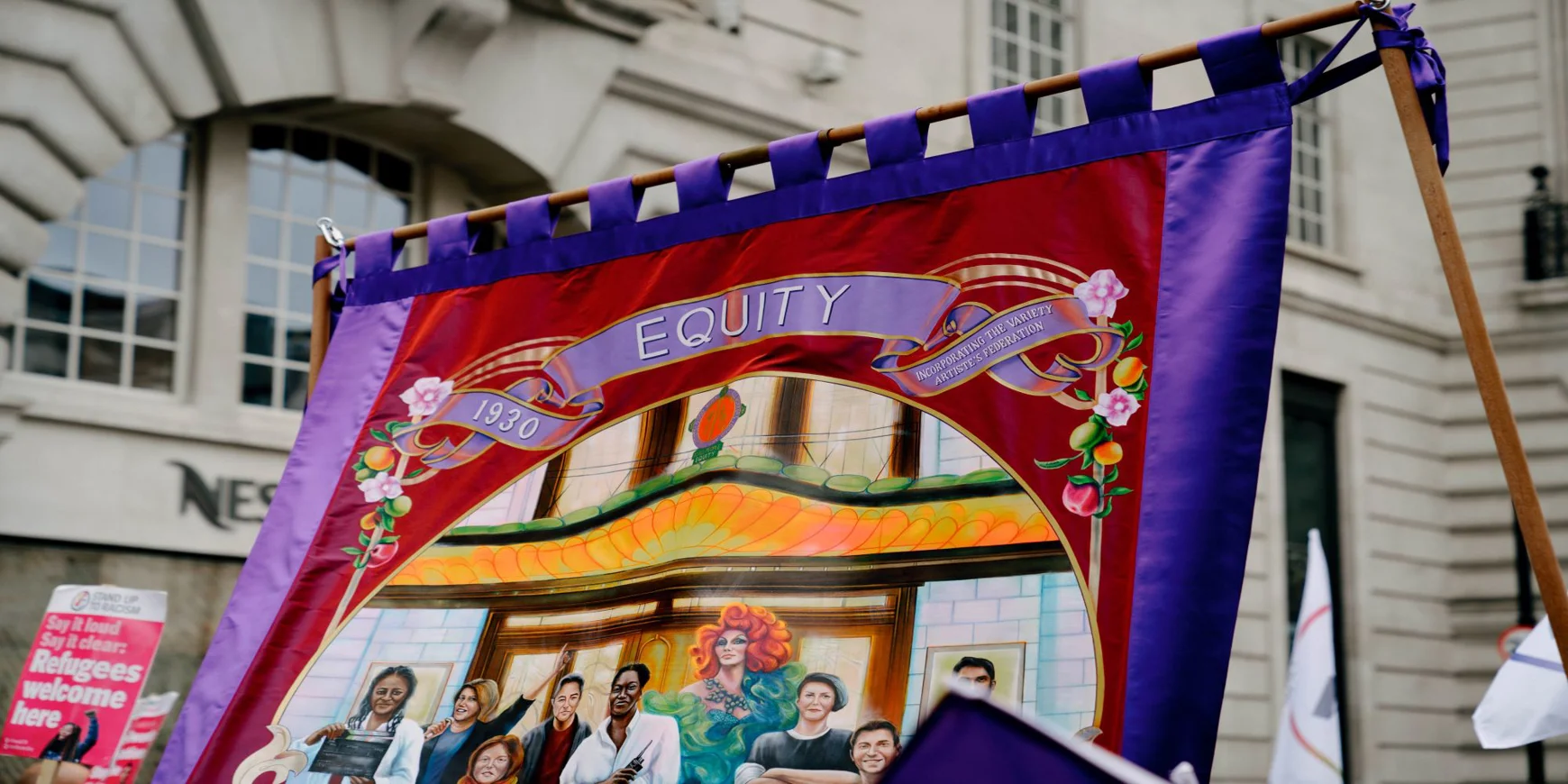
Equity is the UK trade union for professional performers and creative practitioners. Equity is respected as one of the most powerful entertainment unions in the world, and at the heart of the UK trade union movement. We are a growing union of around 50,000 members, proud of our strong organising and campaigning record. Our members are mostly freelance- with many working in greenfield and emerging areas in audio, videogames, dance and the light entertainment sectors. By contrast, most British TV, film and theatre are made on union agreements with minimum terms driving forward industry standards on everything from pay to dignity at work. The Union has a team of staff in offices across the UK who have a wealth of experience and expertise when it comes to advice and representation. They are able to deal with the issues raised by members working in all areas of the industry whether it be a major feature film, a theatre in education show, radio voice overs, a circus act or any other live or recorded work.
Equity is committed to equal opportunities and welcomes applications from all who believe they fit the essential requirements for the job.
The Roles
In three newly created posts, Equity is increasing the organising capacity and coverage for members working across film & TV and theatre and dealing with members' agents and other professional services.
Each role is perfect for someone who will seize the opportunity to expand Equity’s work into new areas, independently develop and implement projects, visiting members in their workplaces to recruit new members and develop activists into the union’s democratic structures.
Ideally you will have experience of working in or with trade unions together with excellent negotiation, communication and advocacy skills, understand the organising agenda, be highly motivated, able to work on your own initiative as well as part of a team and have competent IT skills. You will have an understanding of organising members and supporting members within the local political environment, working in line with the Union’s democratic structures, and operating within trade union law and the Union’s own Rules.
Officials work under the leadership of a Head of Section or member of the Secretariat, and in liaison with the Officials in the Nations and Regions. They are responsible for providing effective negotiations and service to members. The specific areas covered by each Official are set by the relevant member of the Secretariat, and may vary from time to time. Responsibilities may be shared across both Live Performance and Recorded Media Departments.
Agents & Professional Services Official
You will be at the forefront of protecting performers’ rights and shaping fair practices in the entertainment industry. You will support members with everything from contract advice and interpretation to resolving complex disputes over commission, late and non-payments, illegal fees, and agent conduct.
Your work will range from engaging directly with agents on behalf of members, pursuing court claims to monitoring industry practices and collaborating with key stakeholders like the Employment Agencies Standards Inspectorate and the Personal Managers Association to uphold and improve industry standards and advocate for members’ rights.
The role will expand coverage of servicing to cover supporting artists and variety agents, whilst taking a pro-active approach to recruit and organise members around common issues around agent’s contracts and lead on our relationship as a trades union with other services offered to members affecting their access to work, and the management of their freelance careers such as casting platforms
Theatre Official
As a Theatre Official, you will play a vital role in organising and empowering performers, stage managers, and creatives across the entire theatre industry. The Live Performance Department covers the theatre industry from fringe and independent productions to subsidised venues, commercial tours, and the West End, and works together with Officials in the Nations & Regions.
Working as part of a team of Officials in the department and supported by organisers and assistant organisers, you’ll negotiate and enforce collective agreements, visit workplaces, recruit new members, and train workplace reps to build a strong activist network. You’ll handle day-to-day issues such as grievances and disciplinary matters under existing agreements, and where none exist, you’ll seek to negotiate House Agreements to set minimum standards or pay and conditions.
With theatre being one of Equity’s highest-density sectors, this role offers huge organising opportunities, from improving pay and securing a five-day rehearsal week to tackling poor conditions in touring and digs. You’ll lead campaigns that mobilise members to move from resilience to resistance and able to take credible action in upcoming negotiations and shaping the future of terms and conditions in the live sector.
The specific workplaces and agreements covered by this role is to be confirmed.
Supporting Artists & Independent Film Official
As Equity’s Supporting Artists & Independent Film Official, you’ll champion fair treatment for performers in some of the most challenging areas of the industry. From tackling “no and low pay” issues in student films, low-budget independent films, and vertical dramas to safeguarding the rights of supporting artists, who make up a significant part of our membership working in Film & TV.
By visiting and organising workplaces you will ensure their voices are heard and agreements upheld. You’ll lead on collective agreements for TV and film supporting artists, provide expert advice, and drive recruitment campaigns.
As AI reshapes the creative landscape, you’ll also play a key role in distinguishing its use as a workplace tool such as body scanning for digital replicas, ensuring members are protected under law and union agreements. This is a unique opportunity to combine advocacy, negotiation, and innovation to make a real impact in the evolving world of film and television.
How to Apply
Please send your completed application and equalities monitoring form to jobs@equity.org.uk clearly marked as [FULL NAME – OFFICIAL]. CVs sent in isolation will not be considered and only Word-compatible files or PDFs will be accepted.
Job Description and Person Specification
Application Form
Equalities Monitoring Form
The closing date for applications is 23:59 on Monday 19 January 2026.
Interviews are scheduled to be held on 2-4 February 2026.
For further information about the roles, please contact Louise McMullan (Deputy General Secretary) at lmcmullan@equity.org.uk.
Unfortunately, we are unable to provide feedback to all applicants. Therefore, if you haven’t heard back from us by the advertised interview date, your application has been unsuccessful.
Our Vision, Mission, and Values
This is Equity’s proud statement of the world we want to build. It is this vision which drives our whole reason for being – whether it be organising in our industries, or participation in the worldwide trades union movement.
Equity’s members have been told, at best, that resilience to the industrial and political choices which underpin the arts and entertainment industries is admirable. At worst, they have been told to put up and shut up with the inevitable precarity of working in the industries where we organise. The products of their labour have been treated as luxuries or frivolities instead of serious industries underpinning social and economic progress.
The consequence is low pay, precarity, poor health and safety, harassment, bullying, and a mental health crisis. This is systemic and deep rooted – unlike most closed shop unions in the UK and elsewhere in the world (even in our own industries) we have inherited not a high basic pay, but a low one from the attitudes which prevailed from within the union and the industry. Where most unions achieved a 5 day week in the Edwardian era, the six day basic week remains a feature of most members’ working lives.
For a long time, under the closed shop and beyond, the union was viewed as, and sometimes acted like, a regulator rather than a negotiator. This has the legacy of a confused mixture of pride in Equity agreements, but an association of blame with the union for the persistence of bad terms – rather than the bosses who enforce them. Moreover, the union is often an ‘other’, not an organisation where the membership has ownership of its actions, but an organisation which does things to them.
As a union it is our role to collectively shift members’ consciousness and their organisation to a place where they are actively resisting, in every workplace, attacks on their terms and conditions.
Industrial
All action by staff or activists has a clear and conscious industrial outcome. Equity will always place blame on the bosses, and not attempt to behave like a regulator for poor behaviour within the industry. We will not expect government, funders, regulators, HMRC or other third parties to deliver outcomes, but sincerely believe that our industrial processes have the power to. Industry events, benefits for members, and the union’s democratic structures, must be singularly focused on where the union has power.
Accountable
That members and staff have a shared agenda. Equity’s members are the union, and should be those who drive our demands at work, and deliver the outcomes by their organising and campaigning. Members at work or seeking work steer our industrial agenda from survey to strike.
Collective
To resolve individual problems with collective answers. Every member will be treated with compassion and courtesy. Solutions to problems will always initially be industrial, through our advice or agreements. Legal support will be a secondary option, but used in an activist way to further the collective good. Most contractual, employment, equalities, and other workplace disputes will be dealt with by the union’s staff, following the strategies and using the leverage of Equity’s members.
Aspirational
That staff and activists raise the industrial aspirations of the membership.