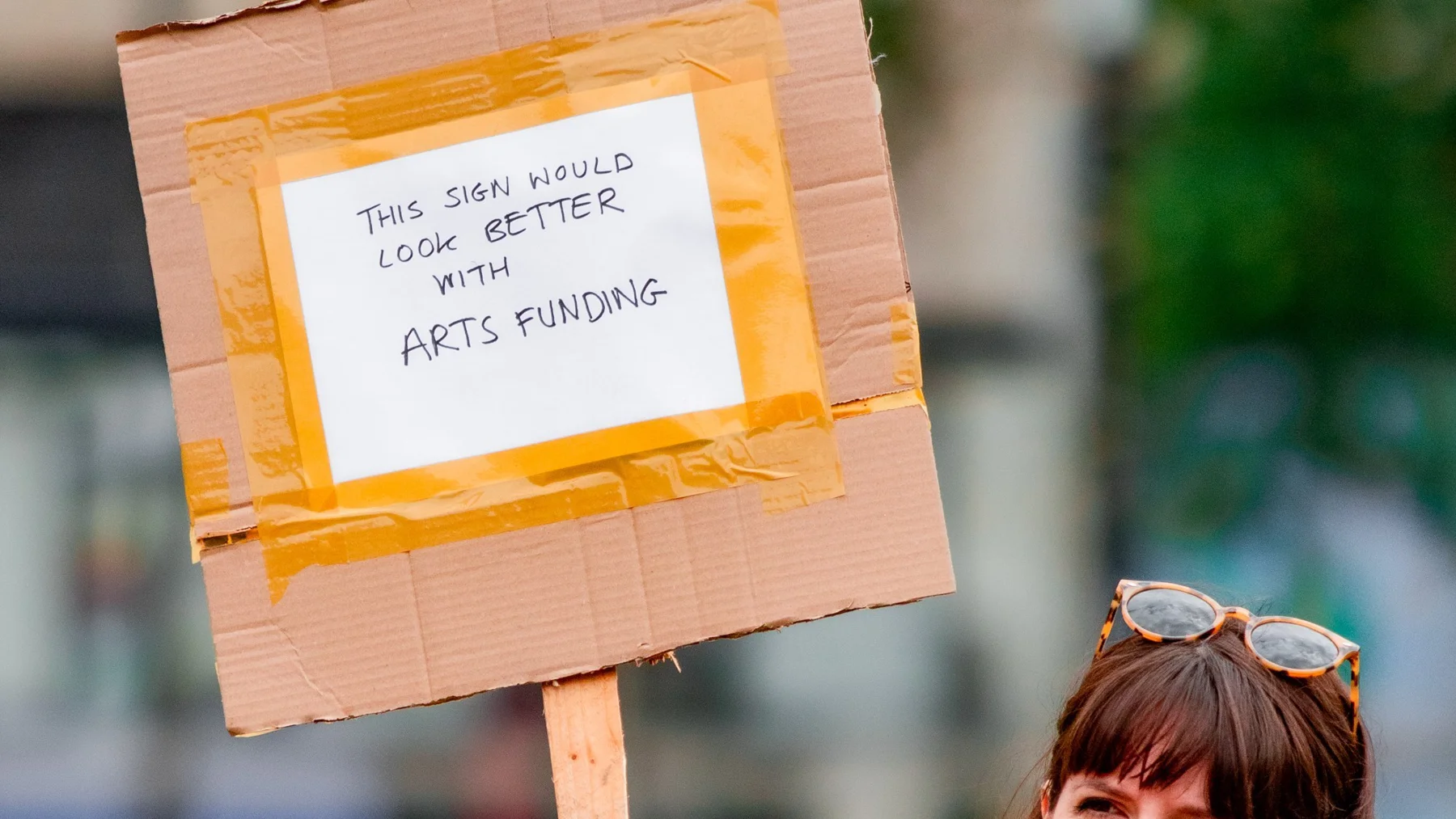
Equity is warning universal access to the arts is “disappearing”, as new research finds local government arts funding has plummeted 55% across Britain since 2010, down from £1.19 billion to just £539 million in 2024-25.
The new analysis of local government arts and entertainment budgets, produced by the Autonomy Institute, shows an unequal fall in each nation:
- England council arts spending fell by 61%, with £660m less in real spending per year in 2024 compared with 2010. Current spending is a mere £6.47 per person, per year, or just over 50p a month. This is down from £18.67.
- Wales has seen a 46% fall, losing around £30m a year for the arts locally. This represents a nearly 50% cut in per capita annual funding on local arts and culture since 2010, from £21.03 to £10.85.
- Scotland’s councils have reduced real spending by 18%, seeing £25m a year less invested in their arts. Scotland has the highest spending per capita, at £20.73 per person, per year, but this is still 22% lower than it was in 2010.
Separately, although Northern Ireland does not have elections this May, and is not included in the analysis due to data issues, it has also seen sharp declines in arts funding.
60% of the 136 English councils up for election in May have cut their real arts funding by more than half since 2010, with at least eight down to zero net arts spend. Only 14% have protected real arts funding over the period.
For the first time in a generation, people across large swathes of this island will not have the opportunity to visit a theatre.
Paul W Fleming, Equity General Secretary
Historically, local government has been the largest source of arts funding across the UK, including theatres, live performance, museums, galleries and more. Equity is calling for investment in arts spending ahead of voters going to the polls on 7 May, saying “defending and extending local arts offers is an essential part of councils’ future success.” The UK government must set out a roadmap for arts spending to reach 0.5% of GDP, which is the European average. This could provide additional resource for local government arts funding.
Commenting on the findings of the research, Equity’s General Secretary, Paul W Fleming, said:
“We are watching universal access to arts and entertainment disappear across Britain as this new research shows the dramatic fall in local authority arts funding.
“For the first time in a generation, people across large swathes of this island will not have the opportunity to visit a theatre. Meanwhile, as funding dries up, it becomes ever harder to make a living as a performer, reducing access to the industry for working class creatives.
“Equity is currently deep in negotiations with subsidised theatre producers who need to increase pay and modernise terms, amidst ongoing austerity in their funding. This task is harder for both parties unless local government re-prioritises growth-leading subsidy for the arts.
“The arts play a vital role in local economies, anchoring night life and driving tourism. Shared stories have the power to bring communities closer together, and arts workers make a huge contribution to our economy and our society.
“As we head towards a pivotal set of local elections in May, Equity’s research is a clarion call to all councillor candidates – defending and extending your local arts offer is an essential part of your council’s future success.”
Arts Funding Tracker
Data is available via Equity’s Local Government Arts Funding Tracker, which is an interactive tool showing how much local authorities spent on arts and culture across 317 authorities in England, 32 in Scotland, and 22 in Wales over 15 years, from fiscal years 2010-11 to 2024-25.
Some local authorities are bucking the trend and have increased their annual net spend on arts and culture since 2010. These include Chorley, Greenwich, Haringey, Islington, Oldham, Tamworth, Wandsworth, and Wigan – where the Secretary of State for Culture, Media and Sport is the local MP.
There is a significant number of local authorities whose net spend on arts and culture is currently nil. These include Adur, Birmingham, Brentwood, Havant, Pendle, Rochford, South Cambridgeshire and Tower Hamlets.