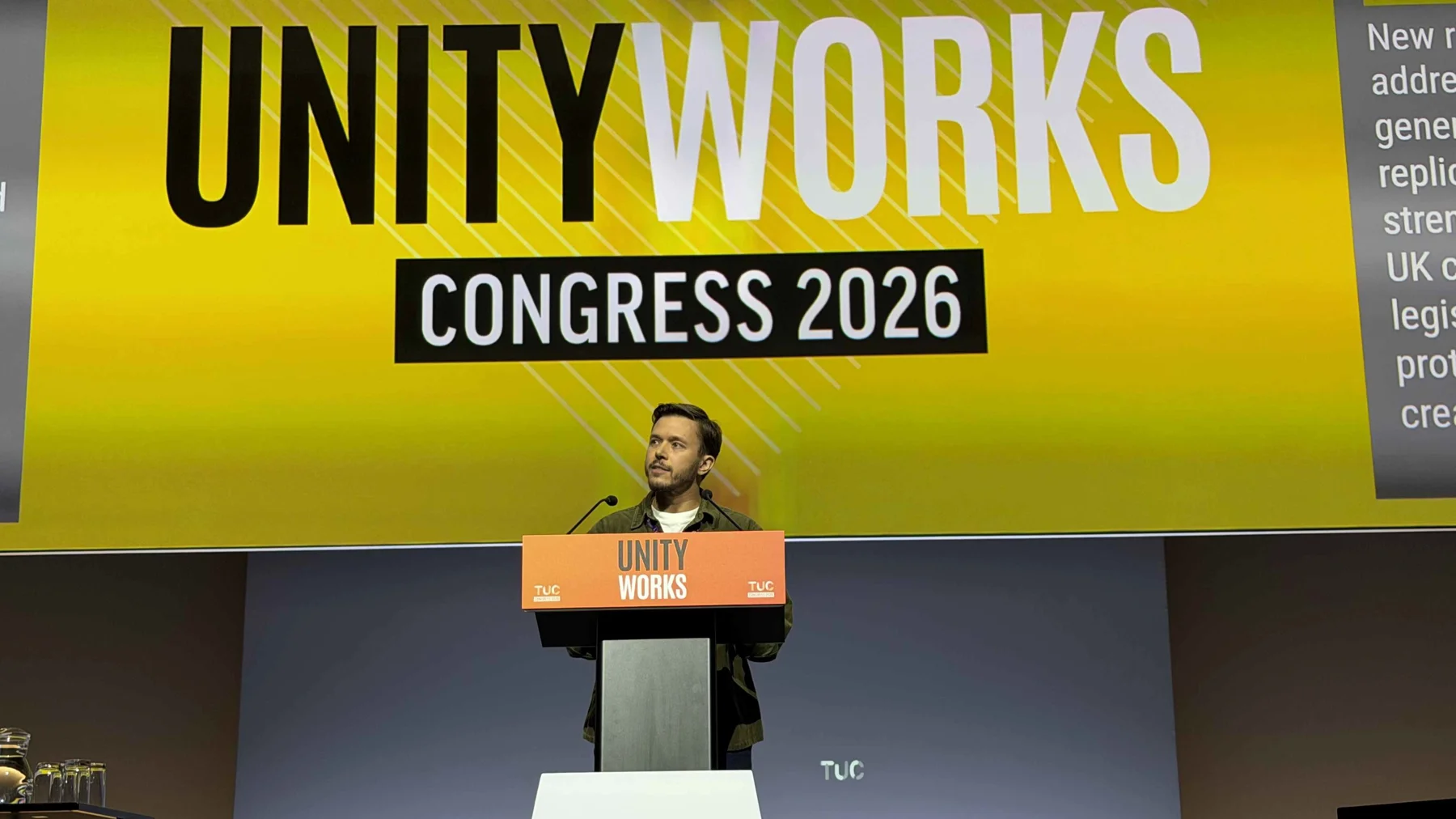
“AI is no substitute for the power of human creativity” said Equity Councillor Jassa Ahluwalia as TUC Congress backed our motion on introducing rights to address AI-generated digital replicas.
Equity has been at the forefront of advocating for new personality rights to be introduced to protect both performers and all people from unwanted AI-generated digital replicas. “AI is not simply a powerful tool, it is a tool of power”, explained Jassa. Seeking the support of delegates representing millions of workers across the UK, he continued: “It is designed to extract wealth out of society and into the hands of billionaires. We must fight back. We must demand the right to choose how, and by whom, this technology is used.”
Watch Jassa’s speech in full:
For Equity members, concerns focus on AI tools creating a digital replica of an individual’s likeness, with many performers, particularly voice artists, finding that after a recording session for a particular purpose, their voice has been cloned and used for other commercial purposes without consent or pay.
Unauthorised digital replicas undermine performers’ income and personal autonomy and pose a threat to the sustainability of careers in performance. Current rights, such as those under UK GDPR and intellectual property, are uncertain and patchy on how they apply in this context and do not provide adequate protection. Women, in particular, may be subject to degrading or misleading ‘deepfakes’ of their likeness disseminated online.
The motion, which was composited with the Writers Guild and National Union of Journalists contributions, recognises the “industrial-scale theft” of writers’ and creatives’ work to train large language models, in breach of existing copyright law. The placement of creative industries at the heart of the government’s growth strategy was also noted, alongside the concern that the lack of any concrete action is leading many to believe that the government is siding with big tech over creators.
Delegates passed the motion unanimously, setting in place a policy position calling on the TUC to:
- lobby the government to introduce personality rights to give performers a clear route to control and license digital replicas within agreed limits, and to give all individuals a clear right to object to a harmful digital replica
- new rights should be enforceable via mechanisms familiar to copyright enforcement, such as notice-and-takedown and compensation for commercial uses
- support licensing for any new rights via existing collective bargaining mechanisms
- call on government to introduce urgent regulation (including transparency measures), to enforce and strengthen existing UK copyright legislation, and to protect jobs in the creative industries in an age of AI
- ensure that any new rights support the ability of news gatherers to take photographs and video for the purposes of reporting, legitimate public scrutiny and the ethical documenting of everyday life
- ensure that creative workers, including journalists, are compensated for the use of their work in ‘training’ AI systems
- ensure that future ‘training’ use is permitted only where the creative worker has granted permission (‘opted in’).
“Equity’s position will always be to champion human-centred creation” said Jassa, but “we are not ideologically opposed to technological progress.” He referenced the position of socialist and artist William Morris, who in 1884 said: ‘It is not this or that tangible steel and brass machine which we want to get rid of, but the great intangible machine of commercial tyranny, which oppresses the lives of all of us.’
Jassa left delegates with the caution that “our machines will never become human, but if we’re not careful, we will make machines of ourselves. We must imagine the future that our machines cannot.”